
How Do Roblox Executors Work?
An executor puts a small code runner inside the Roblox game on your device and feeds it whatever script you hand it. Nothing runs on Roblox's servers, so the whole process starts and ends on your own phone or PC.
- The executor sits on the same device as Roblox. It has to, because the code runner lives inside the game app.
- You open a Roblox game. The game loads the way it always does.
- The executor connects to the running game. Players call this "injecting" or "attaching". A PC executor has an Attach button you press once the game is open. On a phone the extra code is already built into the app, so it is ready when the game loads.
- You paste a script and tap Execute. The code runs in your copy of the game. For Delta, the walkthrough on pasting and running a script in Delta shows each button on Android, iPhone and PC.
Example: Delta. Open Delta's Android file from the developer's download server and you find Roblox's own game engine with extra code libraries bolted on. If you want to try it, start from the Delta Android download.
Roblox Executor vs Roblox Script
The executor is the runner; the script is the list of instructions it runs. A script is written in Luau, the language Roblox games use, which grew out of Lua 5.1. Plenty of players never write one and copy a published script instead. What a Roblox script is sets an exploit script beside the code a game's own creator writes.
What Can a Roblox Executor Change?
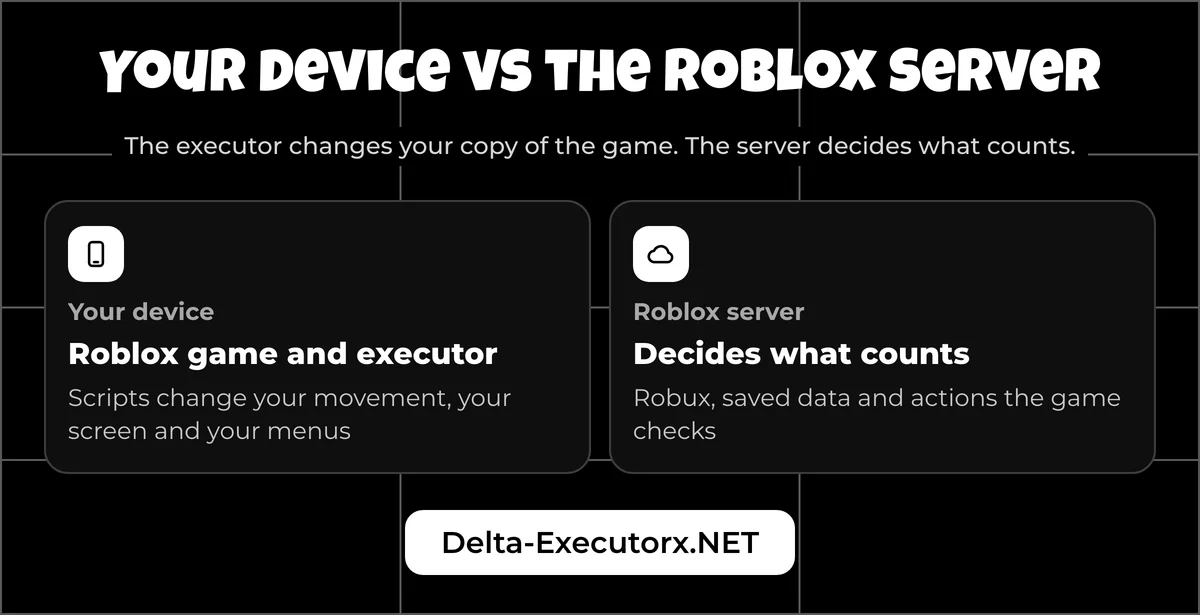
An executor can change almost anything in your own copy of the game: your movement, what your screen draws and the menus you see. It cannot touch what Roblox's servers own, such as Robux, other players' saved data or any action the game checks on the server.
Roblox builds its own advice on this split. Its security guide for game creators calls "never trust the client" the foundation of game security. It warns that an exploiter "has complete control over their local state" and tells creators to make the server the final source of truth. The same guide says an exploiter can fire a game's RemoteEvents "at any frequency with arbitrary arguments". A script reaches other players only in a game whose server takes those messages on trust.
| What a player tries | Possible? | Reason |
|---|---|---|
| Change speed, jump or position | Often | Your device controls your own character's physics, so other players may see the change |
| See players through walls, highlight items | Yes | It only changes what your screen draws |
| Auto-click or auto-farm | Yes, but it can be flagged | It repeats actions the game allows, and the server can still check them |
| Add a menu or extra buttons | Yes | Menus live on your device |
| Get free Robux | No | Robux live on Roblox's servers |
| Edit another player's items or progress | No | Saved data lives on the server |
| Change a game's rules for everyone | Rarely | Only where the game's server accepts whatever a device sends through its remote events |
| Lift a ban set by a game's owner | No | Game owners ban from their side |
What Is a Roblox Executor Used For?
Players reach for one to skip the grind. They use executors to auto-farm games built on repeat tasks, to run faster or fly, to spot items and players through walls, and to load admin menus packed with commands. Roblox's rules ban every one of those uses, which is why they put the account at risk.
Do Executors Work in Every Roblox Game?
Any executor can open any game, yet a script built around one game's menus and remotes does nothing useful in another. Games that switch on Roblox's Server Authority check movement on the server, so speed and fly tricks stop there. Only a handful of universal scripts like Infinite Yield are written to run anywhere.
What Types of Roblox Executors Exist?
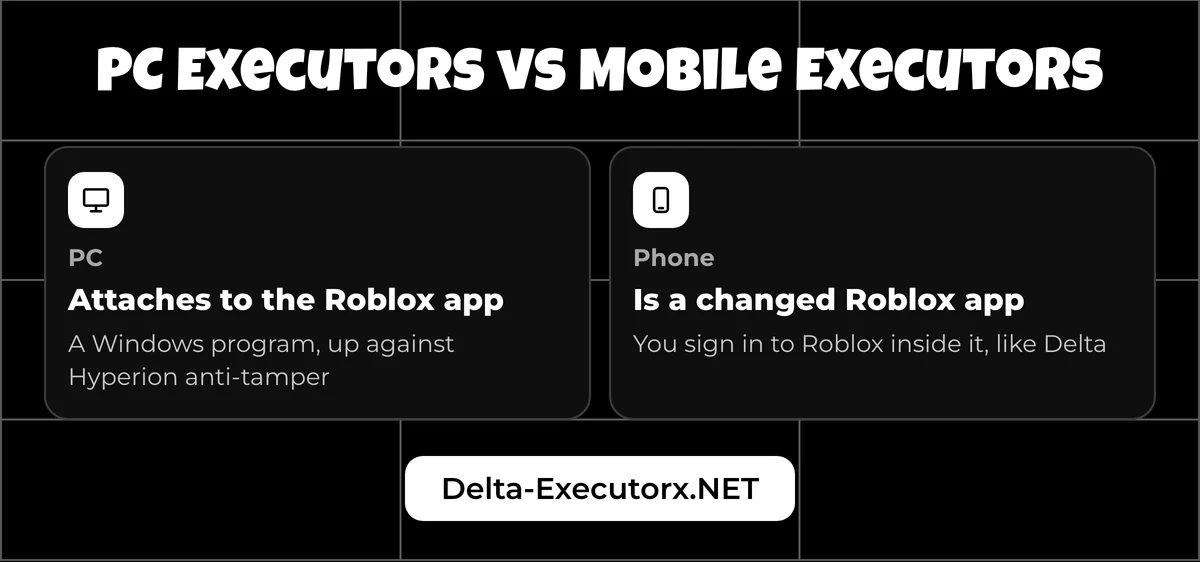
Executors split into two kinds: internal ones that run code inside the Roblox app, and external tools that work from outside it. Internal executors take two forms, a PC program that attaches to Roblox and a changed Roblox app on phones. "Server-side" and "online" executors are labels from ads, not real types.
| Type | Devices | How it runs | Runs scripts? | Main risk |
|---|---|---|---|---|
| Internal, PC attach | Windows | A program attaches to the running Roblox app | Yes | Roblox's Windows anti-tamper, fake downloads |
| Changed app | Android, iOS | Its own Roblox app you sign in to | Yes | Account action for a modified client, fake APK or IPA files |
| Emulator route | PC running a phone app | A mobile executor inside an Android emulator | Yes | Roblox kicks emulator players from games they can't edit |
| External | Windows | A separate program that works on the game from outside the Roblox app | Some do, with fewer functions | Fake downloads |
| "Server-side" | Inside one game | A hidden backdoor someone planted in that game | Only there | Scams sold as executors |
| "Online / no download" | A website | Nothing reaches your game | No | Offer lockers and malware |
Sellers pitch "server-side" as a stronger kind of executor. A real one only works in a game where somebody already planted a backdoor, which is the subject of FE, require and server-side scripts.
Executors for Mobile
A mobile executor is a whole Roblox app with extra code inside it. You install it beside the normal Roblox app, or in its place, and sign in to Roblox from inside that app. Delta's files show this, and the mobile install steps Codex published before it went Windows-only said the same thing: you launched a "modded Roblox".
On iPhone the executor installs as a separate signed app, so an App Store update to Roblox never reaches it. Getting that sideloaded copy onto an iPhone or iPad is its own process, laid out in the Delta IPA install steps.
Executors for PC
On PC, executors are Windows programs that attach to the Roblox app, and that became far harder in 2023. That year the 64-bit Windows Roblox app began shipping with Hyperion, an anti-tamper system from Byfron, a company Roblox bought in 2022. Delta sidesteps this fight entirely, since it has no Windows build and its emulator route on a computer runs the Android app instead.
Internal vs External Executors
Internal executors run their code inside the Roblox app, so scripts get the full set of functions. External ones work on the game from outside the app. Some, like the free Windows tools Xeno and Solara, still run Luau scripts but lack functions such as hooks. Others only draw overlays and run no scripts at all.
Is There an Online Roblox Executor?
No. Roblox games run in the Roblox app on your device, so a stranger's website has no way into your session. Roblox said in September 2026 that games will become playable in the Chrome browser by the end of 2026. Even then, a third-party site will not reach into your game.
Pages that promise an online or no-download executor are ads, and many end in offer lockers or fake files. The few real ways to run code with no executor, such as Roblox Studio in your own game, are sorted from the myths in Studio and other executor-free options.
How to Get and Use a Roblox Executor
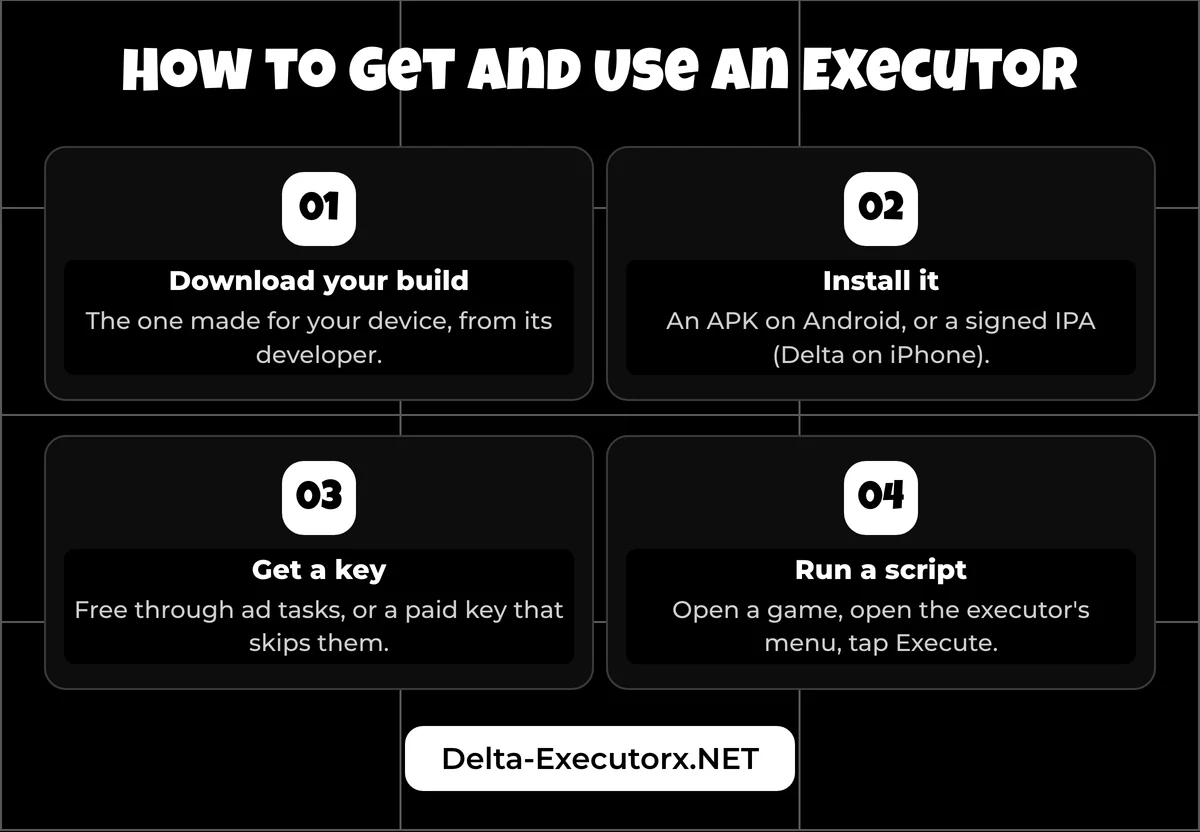
You get an executor by downloading the build for your device from its developer and installing it. Mobile executors install like apps: an APK on Android, or in Delta's case a signed IPA on iPhone. To use one, open a game, open the executor's menu and run a script.
Free executors then ask for a key. You earn a temporary one by clearing ad tasks on a website, and some developers sell paid keys that skip the tasks. Delta works this way: you copy a link inside the app and earn the free Delta key on that site.
The download step is where players get hurt, because fake builds copy real names. The same caution applies to script files, and a ranked list of script sources shows which ones earn trust.
When Execute does nothing, check three things: an executor older than your Roblox app, an expired key and a script written for another game. A step-by-step Delta diagnosis tests them in order.
Why Do Executors Break After Roblox Updates?
Every executor is built against one version of the Roblox app, so a Roblox update can leave it dead until its developer ships a matching build. The prompts players see in that gap, and the safe way through them, are on the Delta upgrade error page.
Are Roblox Executors Safe?
No executor is risk-free, and the risk sits in two separate places. A real executor can still get your Roblox account banned, and a fake one can infect your phone or PC with malware.
Can You Get Banned for Using an Executor?
Yes. Running one breaks Roblox's Terms of Use, and the penalty lands on the account you signed in with, as how Roblox catches executor users explains case by case.
Fake Executors and Malware
Roblox's own help page warns that many exploits are scams to get you to install malware, such as a keylogger that grabs your password. Security firms have tracked this pattern for years:
- Fake Xeno downloads (2026): In August 2026 Bitdefender reported fake "undetected" Xeno executors passed around on Discord, gaming forums and hijacked accounts since early 2026. They stole browser cookies, Discord and Roblox accounts, payment data and crypto wallets, and could log keystrokes, take screenshots and switch on the webcam.
- Fake Solara and Electron sites (2024): In October 2024 Morphisec found look-alike executor sites, pushed up in search results, serving zip files hosted mainly on GitHub. The files installed password-stealing malware aimed at student gamers.
- Older cases: ESET reports that a 2022 copy of Synapse X carried a backdoor, and that fake Solara executors spread on social media, one carrying a ransomware variant.
Each fake borrowed a real executor's name, so on a download page it can look identical to the genuine tool.
Is an Antivirus Warning a False Positive?
Not by default. A HackTool or PUA label in Microsoft Defender points to a cheat tool, while Trojan, Backdoor, Ransom or PWS points to malware. Delete a file with one of those last four labels, however loudly the download page calls it safe. Two more signs of a fake download are a password-protected zip and advice to turn off your antivirus.
Can You Make Your Own Roblox Executor?
Not without breaking Roblox's rules, because building one means reverse-engineering Roblox, which the Terms of Use forbid. Curious players have two legal routes instead.
- Roblox Studio is Roblox's free tool for writing and running your own Luau code. It runs on Windows and Mac, not on phones or Chromebooks.
- Roblox's bug bounty on HackerOne takes reports of real security bugs, and valid reports "are eligible for financial rewards" when testing stays inside the program's scope.
If what you really want is your own menu of scripts, you can build a script hub in Studio without a line of executor code.
Executor Terms Glossary
Alt account : A second Roblox account kept apart from your main one.
API : The shared code core that some older PC executors were built on.
Attach / inject : The step where an executor connects its code runner to the running Roblox game.
Auto-execute : Scripts that run by themselves each time the executor loads; the guide to auto execute in Delta shows where those files go.
Ban wave : Many accounts banned at once.
Client / server : The client is your device's copy of the game. The server is Roblox's computer that decides what counts.
Detected / undetected : Whether Roblox's anti-cheat currently spots an executor. It is the seller's claim, not a promise.
Emulator : A PC program that runs phone apps.
External : A program that works on the game from outside the Roblox app. Some run scripts with fewer functions; others only draw overlays.
Hyperion (Byfron) : Roblox's anti-tamper system, built into the Windows Roblox app.
Key system / Premium key : A free key earned through ad tasks, or a paid key that skips them.
Level : The permission level an executor's code runs at, not a quality score. Sellers report it themselves, and labels like "level 8" are unpacked in executor levels, UNC and sUNC.
Loadstring : A one-line script that downloads a longer script from the web and runs it. Each part of the line is explained in what a loadstring is.
Luau : Roblox's scripting language, based on Lua 5.1.
Modified client : A Roblox app rebuilt with extra code. Mobile executors such as Delta work this way.
Script hub : A menu that bundles many scripts, so you pick one instead of pasting code.
UNC / sUNC : Community test lists that count which functions an executor supports. Scores are self-reported.
FAQ
What does an executor do when someone dies?
Outside Roblox, an executor is the person named in a will to carry out its instructions after someone dies. In Roblox the word means something else: a program that carries out code.
Are Roblox executors illegal?
Using one breaks Roblox's Terms of Use, so Roblox can delete the account, but that is a rules question rather than a court one. The clearly criminal part is spreading malware inside fake executors.
Is Delta a Roblox executor?
Yes. Delta is a mobile executor for Android and iOS that works as a changed copy of the Roblox app and needs a key to run.
Are open-source Roblox executors safer?
Only if you can read and build the code yourself. A ready-made build from a stranger can still hide malware, and fakes copy real projects closely.
Is Bloxstrap a Roblox executor?
No. Bloxstrap is a launcher that does not run scripts, and Roblox said its May 2025 modified-client rule shouldn't affect it because it "does not modify the client binary". Roblox also says it doesn't officially support it.
Conclusion
An executor rewrites your own copy of a Roblox game and never the server's records, and on a phone it is a whole rebuilt Roblox app rather than an add-on. Real ones risk the account and fake ones carry malware, so where you download matters as much as which tool you pick. Which one suits a phone or a Windows PC is settled in the side-by-side executor picks.